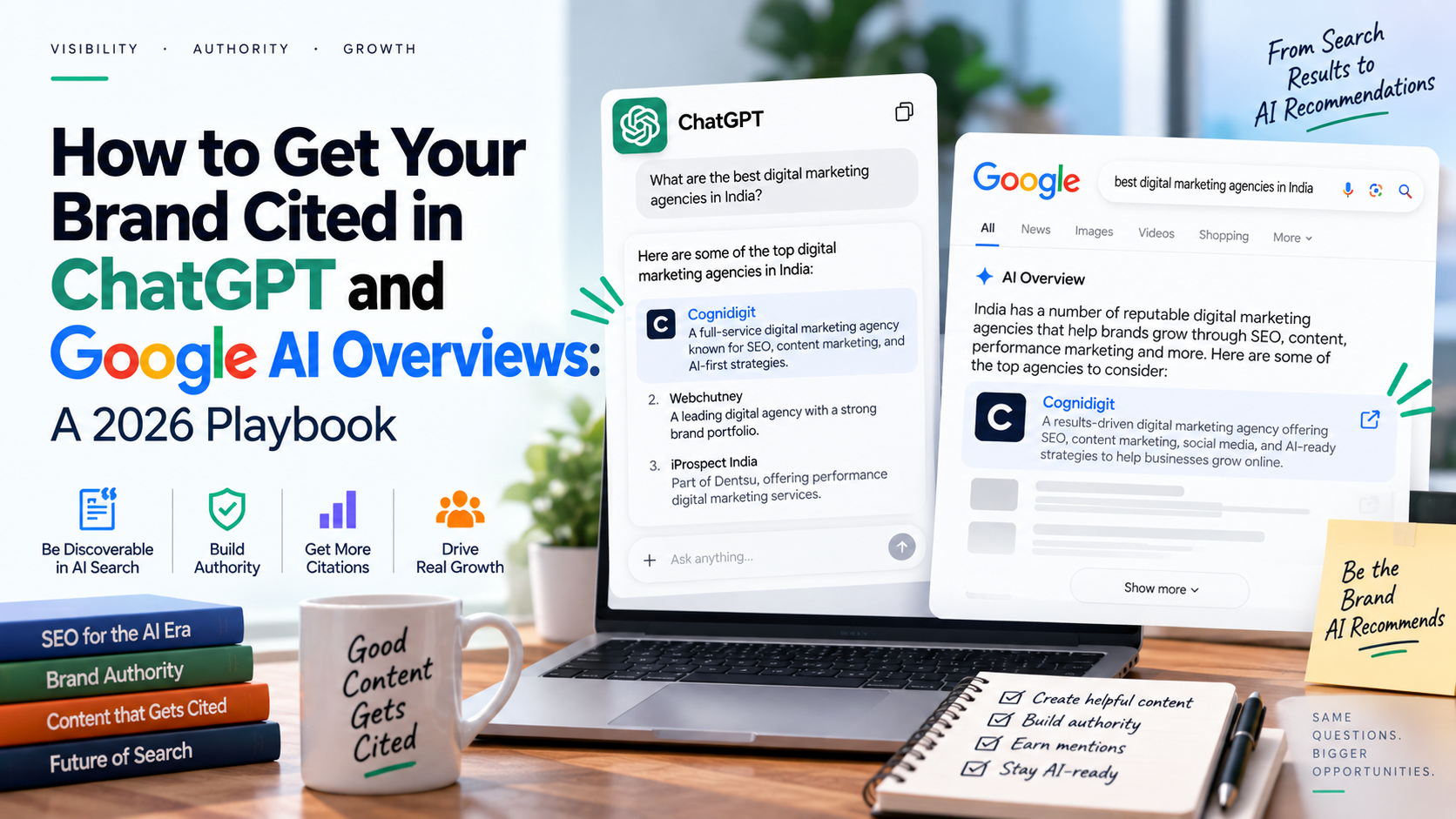
Brands earn AI citations in ChatGPT and Google AI Overviews by becoming sources worth pointing to, not just pages that rank. That means building a consistent brand and entity identity, publishing clear, answer-first content, demonstrating real expertise and authority, creating original and verifiable evidence, earning credible third-party mentions, keeping content technically accessible, and continuously monitoring the prompts and platforms where citations happen.
None of these tactics work in isolation — AI search engines evaluate brands the same way a careful researcher would: is this source clear about who it is, easy to verify, and worth referencing? The rest of this guide breaks down exactly how to build that profile, section by section, from foundational entity work through measurement.
AI answer engines don't rank pages the way traditional search does. They perform retrieval, evaluate candidate sources, and decide what earns a place in the generated response — a process where AI visibility, source selection, and attribution all work differently than classic SEO. Understanding that distinction is the foundation everything else in this playbook builds on.
What Does It Mean to Be Cited in ChatGPT or Google AI Overviews?
What Is an AI Citation?
An AI citation happens when an AI-generated response directly draws on your content as a citation source — either through visible source attribution, a linked reference, or content that's clearly synthesized from your material. It's a specific, evaluable outcome, not a vague sense that "AI knows about us."
This is different from simply showing up in a web index or being crawlable. A citation means your content passed through source selection and became part of what the model chose to reference on a specific answer surface.
Brand Mention vs Brand Citation
Mention ≠ Citation, and the distinction matters more than most brands realize. A brand mention is any reference to your company's name inside an AI response — it might appear in passing, without your content ever being the underlying source.
A brand citation is different: it's when your company is the cited source or referenced brand behind a specific claim, often (though not always) with a linked source back to your page. Brand recognition helps you get mentioned; source attribution is what gets you cited — and the second one is what actually drives traffic, trust, and authority.
Where Can Your Brand Appear?
AI citations aren't limited to one platform, and each surface behaves slightly differently:
- ChatGPT citations — appearing in ChatGPT's browsing-enabled or search-integrated responses
- Google AI Overviews — the AI-generated summary block above traditional search results
- Google AI Mode — Google's more conversational, multi-turn AI search experience
- Perplexity citations — Perplexity's answer engine, which surfaces sources prominently by design
- Gemini visibility — appearing in Google's Gemini assistant responses
- Microsoft Copilot — Microsoft's AI assistant, often pulling from Bing's index
- Other AI-generated answers across emerging assistants and search experiences
A brand doesn't need to chase every platform equally. Tracking where your buyers actually search is what determines which of these surfaces deserves the most attention.
How AI Search Engines Choose Sources to Cite
How AI Retrieval and Source Selection Work
At a high level, most AI answer engines follow a similar pattern:
User query → Retrieval → Candidate sources → Source evaluation → Answer synthesis → Attribution
The systems behind this vary by platform. Some rely on large language models (LLMs) paired with retrieval-augmented generation (RAG), pulling from a web index at query time. Others use browser-enabled models that perform live web search directly, evaluating pages in real time rather than from a pre-built index. Either way, source selection happens before the answer is written — your content has to clear that bar before it can ever be cited.
What Makes a Source Citable?
Across platforms, a consistent set of signals determines what gets selected as a citation source:
- Relevance — does the content directly answer the query being asked?
- Authority — does the source have established topical authority on the subject?
- Evidence — does the content back up its claims with data, examples, or specifics?
- Entity clarity — is it obvious who the author or organization behind the content is?
- Accessibility — can the content actually be crawled, rendered, and parsed?
- Freshness — is the information current, or does it read as outdated?
- Independent corroboration — do other credible sources support or reference the same information?
Content that's strong on relevance but weak on the others rarely becomes a citation source — AI discoverability depends on clearing most of these bars simultaneously, not excelling at just one.
Why AI Citations Are Different From Traditional Rankings
Ranking on page one of Google does not automatically mean being cited by an AI answer engine, and it's worth being direct about why. Traditional rankings reward relevance and backlink authority within a ranking algorithm; AI citation depends on whether a specific passage is clear, evidence-backed, and extractable enough for a model to confidently attribute a claim to it.
A page can rank well and never get cited if its content buries answers in long introductions or lacks the entity clarity models look for. The reverse also happens — a well-structured page from a smaller domain can earn a citation a much bigger competitor misses, simply because it answered the question more directly.
AI SEO vs GEO vs AEO: What Should Brands Actually Optimize For?
What Is Generative Engine Optimization (GEO)?
Generative engine optimization (GEO) is the practice of optimizing content and brand signals specifically for generative AI systems — ChatGPT, Gemini, Copilot, and similar tools — rather than traditional search rankings alone. It overlaps heavily with LLM optimization and AI search optimization, all describing the same underlying goal: making content legible and citable to generative models.
What Is Answer Engine Optimization (AEO)?
Answer engine optimization (AEO) focuses specifically on structuring content so it can directly answer a query — the kind of answer-first content and extractable content that AI systems can lift cleanly into a generated response. Where GEO is the broader discipline, AEO is the tactical layer concerned with how individual answers are written and structured.
How GEO and AEO Work With Traditional SEO
None of this replaces traditional SEO — it builds on top of it. The realistic stack looks like:
Traditional SEO foundation + entity optimization + answer structure + authority + evidence + monitoring
A technically sound, well-ranking site is still the starting point. GEO and AEO add the entity clarity, answer formatting, and evidence layers that determine whether that same content also becomes citable — and ongoing monitoring is what confirms whether the effort is actually working.
Build a Strong Brand Entity Before Trying to Earn AI Citations
What Is Entity SEO?
Entity SEO is the practice of establishing your business as a clearly defined, unambiguous entity that search and AI systems can confidently identify. It centers on entity recognition: making sure your brand entity and organization entity are consistently understood across the web, along with the semantic entity and entity associations that describe what your company actually does.
Every AI system implicitly asks the same basic question before citing a source: who is this company, what does it do, and what topics should it be associated with? Entity SEO exists to make that question easy to answer.
Create a Consistent Brand Identity Everywhere
Entity clarity starts with consistency, applied relentlessly across every place your brand appears:
- A canonical business name, used identically everywhere — no shortened variants on one page and full legal names on another
- A clear, consistent brand description that doesn't shift meaning between your homepage, LinkedIn, and press materials
- An accurate company category that correctly reflects your industry and business type
- Consistent company information — address, founding details, leadership — matching across every platform
- A substantive about page that actually explains who you are, not a placeholder paragraph
- A real founder profile and author profile for the people behind the brand
Strengthen Your Entity Across the Web
Beyond your own site, entity signals compound through legitimate presence across recognized platforms:
- Knowledge graph and knowledge panel presence, where applicable
- A properly maintained Wikidata entry
- Wikipedia coverage, where the brand genuinely meets notability standards
- A complete, verified Google Business Profile
- An active, accurate LinkedIn company page
- Relevant industry profiles on platforms specific to your sector
None of these should be treated as shortcuts or growth hacks. The goal is consistent, legitimate corroboration — the same entity information appearing accurately in enough credible places that AI systems have no ambiguity about who you are.
Create Content That AI Systems Can Easily Extract and Cite
Use Answer-First Content
Answer-first content leads with the answer, not the setup. The strongest pattern for a citable page opens with a direct answer — an answer capsule: a concise, self-contained paragraph that could stand alone as a citable passage — before moving into supporting detail.
This isn't just an AI-optimization trick; it mirrors how featured-snippet style answers have always worked. A self-contained answer, written in short sentences with contextual explanation following afterward, gives models exactly the kind of quotable content they need to extract cleanly.
Match Content to Real User Questions
Content earns citations when it mirrors how people actually ask questions — including the more conversational phrasing typical of AI search. That means writing for:
- Conversational queries phrased the way someone would actually speak
- Prompt-based queries that mirror how users type into ChatGPT or Copilot
- Real buyer questions, not just keyword-research terms
- Long-tail questions with specific, narrow intent
- High-intent prompts signaling someone close to a decision
A reliable format for this kind of content follows: question → direct answer → explanation → evidence → example → next step. This structure, often called query mirroring, gives AI systems a clean, predictable shape to extract from.
Use Question-Based Headings
Question-based headings — structured as H2 and H3 elements — help both readers and AI systems scan a page and quickly identify where a specific answer lives. Favor query-mirroring headings written in natural Q&A format:
- "What is...?"
- "How does...?"
- "Why does...?"
- "How much does...?"
- "What is the difference between...?"
This heading style does double duty: it improves scannability for human readers and gives AI crawlers an unambiguous map of exactly what each section answers.
Build Self-Contained, Citable Passages
A citable passage needs to make sense read on its own, stripped of everything around it — because that's often exactly how an AI system will use it. Structural choices that support this include:
- Short sentences over long, clause-heavy ones
- Clear definitions stated plainly, not implied
- Standalone paragraphs that don't depend on the sentence before them for meaning
- Bulleted lists for anything with discrete parts
- Numbered steps for sequential processes
- Comparison tables with clear table labels for anything involving options or trade-offs
Every one of these choices makes a passage easier to lift cleanly into a generated answer — which is precisely the goal.
Build Topical Authority and Demonstrate E-E-A-T
Demonstrate First-Hand Experience
First-hand experience is one of the hardest signals to fake, and AI systems increasingly reward content that shows it. That means leaning on:
- Real customer outcomes, described specifically rather than in vague terms
- Detailed case studies with actual numbers and context
- Practical examples drawn from real implementation, not hypotheticals
- Expert analysis that goes beyond restating what's already publicly known
Make Expertise Visible
Expertise only counts as a citation signal if it's actually visible on the page, not just implied. That requires:
- Content written or reviewed by a genuine subject-matter expert
- A named author on every substantive piece of content
- Visible author credentials that establish relevant background
- A real author bio, not a generic placeholder
- Expert quotes, attributed to a specific, identifiable person
Strengthen Trust
Trust signals round out the E-E-A-T picture — experience, expertise, authoritativeness, and trustworthiness — that both search and AI systems evaluate. Strengthen this with:
- Clear editorial standards governing how content gets published and corrected
- A stated methodology wherever claims or data are involved
- Visible source citations pointing to primary sources
- Evidence of fact checking as part of the editorial process
- A visible last reviewed date on evergreen or frequently-updated content
Together, these signals are what separate a page that merely sounds authoritative from one that demonstrably is — and AI systems, like careful readers, tend to notice the difference.
Publish Original Research That AI Systems Have a Reason to Cite
Why Original Data Creates Citation Opportunities
There's a fundamental difference between repeating existing information and creating primary information. AI systems have no particular reason to cite a page that restates what a dozen other sources already say — but they have every reason to cite the page that originated the data everyone else is now referencing.
Original research, proprietary data, and first-party data give AI systems something genuinely new to attribute, which is exactly what turns a brand into a primary source rather than one more voice repeating consensus.
Content Assets That Can Become Primary Sources
Several content formats are particularly well-suited to becoming genuinely citable primary sources:
- Benchmark reports comparing performance across a category
- Industry surveys capturing original sentiment or behavior data
- Original statistics your business is uniquely positioned to produce
- Data studies analyzing a specific trend or problem
- Broader research reports synthesizing findings into a clear narrative
- Proprietary datasets made available for others to reference
- Expert analysis interpreting what the data actually means
- Case studies documenting a specific, verifiable outcome
Make Research Verifiable
Original research only earns citations if it's credible enough to reference confidently. That means including:
- A clearly stated methodology, not just a headline number
- Full methodology disclosure covering how data was collected
- The data source behind every figure
- Sample size, where relevant to interpreting the results
- Expert attribution for any analysis or interpretation
- Supporting evidence for every major claim
- A visible publication date and, where updated, a last reviewed date
A statistic without a visible methodology is far less likely to be cited than the same statistic with a clear, verifiable source behind it — AI systems, like human researchers, favor sources they can actually check.
Earn Third-Party Brand Mentions and External Authority
Why Independent Mentions Matter
Third-party brand mentions function as corroboration — a signal that your authority on a topic isn't just something you claim about yourself. AI systems weigh this kind of third-party validation heavily, drawing on:
- Editorial mentions from independent publications
- Expert quotations attributed to people at your company
- Genuine reviews from real customers
- Comparison pages where your brand is discussed alongside competitors
- Coverage in industry publications relevant to your space
Build Contextually Relevant Digital PR
Digital PR and earned media remain some of the most effective ways to build this kind of external authority. Worthwhile channels include:
- Coverage in industry publications and reputable publishers
- Expert contributions to established outlets
- Guest articles on relevant, credible sites
- Appearances on podcasts and webinars
- Co-authored research with an established partner or publication
Get Listed Where Buyers Research Brands
Buyers researching a purchase decision — and increasingly, the AI tools helping them research — both draw heavily on review and directory platforms:
- Review platforms broadly
- G2
- Capterra
- Trustpilot
- Relevant directory listings
- Product listings on category-specific marketplaces
- Industry directories specific to your sector
Earn Mentions in Communities
Community platforms deserve careful handling, but they're increasingly influential sources for AI-generated answers:
- Quora
- Specialist, niche communities relevant to your industry
The emphasis here has to be genuine contribution, not artificial brand promotion. AI systems — and the communities themselves — are generally good at detecting manufactured engagement, and a brand caught gaming these platforms risks more credibility damage than it gains.
Win Comparison, Alternative and "Best Of" Searches
Create Comparison Content
Commercial, decision-stage prompts — "X vs Y," "which is better for..." — often produce some of the highest-value AI answers a brand can be cited in. Build this out with:
- Brand vs competitor content, written fairly and specifically
- Detailed product comparisons
- Dedicated comparison pages for your most-searched competitive matchups
Create Alternatives Pages
Alternatives pages capture a specific, high-intent search pattern — someone actively looking to switch. Worth building:
- Direct alternatives pages ("[Competitor] alternatives")
- Awareness of how your brand appears on third-party review sites covering the same competitor alternatives queries
Get Included in Category Roundups
Best-of lists and buyer guides are exactly the kind of structured, comparative content AI systems draw on heavily for commercial queries. Target:
- Best-of lists in your category
- Comprehensive buyer guides
- Category roundups published by trusted third parties
- Comparison articles covering your competitive set
A best-of roundup or comparison article on a respected review platform often carries more AI citation weight than the same claim made on your own site — which is exactly why this kind of external validation deserves deliberate outreach, not passive hope.
Implement Structured Data and Technical SEO for AI Discoverability
Make Your Website Crawlable and Indexable
None of the content and authority work matters if AI systems and search crawlers can't actually reach your pages. The baseline technical requirements:
- Confirmed crawlability with no unintended blocks
- Reliable indexability across key pages
- A correctly configured robots.txt that doesn't accidentally exclude important content or AI crawler user agents you want access
- Accessible to both AI crawler and standard search crawler traffic
- A current, accurate XML sitemap
- Proper canonical URL usage to avoid duplicate-content confusion
- Clean HTTP status codes — no broken pages returning soft 404s or redirect chains
Make Content Technically Accessible
Beyond basic crawlability, how content is delivered technically affects whether it's fully readable by AI systems:
- Server-side rendering where possible, since not every crawler executes JavaScript rendering reliably
- Strong page speed, which affects both crawl efficiency and user experience
- Solid mobile usability, given how much AI-assisted search happens on mobile
- Thoughtful internal linking connecting related content and reinforcing topical structure
Use Schema Markup to Clarify Entities
Structured data, implemented as schema markup — typically via JSON-LD — gives machines an explicit, unambiguous description of what's on a page. Relevant schema types include:
- Organization
- Person
- Product
- Service
- Article
- FAQPage
- Review
- LocalBusiness
- Breadcrumb
It's worth being direct here: schema can meaningfully improve machine understanding of your content, but it does not guarantee AI citations on its own. Treat it as a clarity layer that supports everything else in this guide, not a shortcut that replaces strong content and genuine authority.
Use FAQs and Question-Led Content Strategically
Find the Questions Buyers Actually Ask
Effective FAQ content starts with real questions, not a brainstormed list. Sources worth mining include:
- Actual conversational queries and prompt-based queries customers use
- Genuine buyer questions from sales calls and support tickets
- Long-tail questions surfaced through search and AI query data
- High-intent prompts signaling someone close to a decision
Build Question-to-Answer Content
The most citable FAQ format follows a consistent, predictable shape: question → 40–100-word answer → supporting explanation → evidence. Keeping the initial answer tight is deliberate — it's short enough to lift cleanly into an AI-generated response while still being complete enough to stand alone.
Avoid Generic FAQ Filler
A weak FAQ section is one of the easiest ways to waste a citation opportunity. Strong FAQ content requires:
- Real user questions, not filler invented to pad the page
- Accurate answers that hold up to scrutiny
- Original information, not a repackaged version of a competitor's FAQ
- Clear structure that separates question from answer visually
- Visible content — not hidden behind accordions that some crawlers can't reliably parse
Keep Your Content Fresh and Current
Establish a Content Refresh Process
AI search is particularly sensitive to information that may have quietly gone stale, which makes a deliberate content refresh process worth building into your editorial calendar. That means:
- Scheduled editorial updates on evergreen and high-traffic pages
- Ongoing content maintenance, not just publish-and-forget
- Verification that cited data still reflects current data
- Incorporation of recent research as it becomes available
Show When Content Was Reviewed
Freshness signals need to be visible, not just true. Display:
- The original publication date
- A clear last updated date
- A last reviewed date, distinct from a cosmetic edit, showing the content was actually re-verified
Update Evidence, Statistics and Claims
Refreshing a page isn't just about changing the displayed date — the underlying substance needs updating too:
- Replace outdated figures with current data
- Incorporate new research as it's published
- Reflect updated benchmarks where the underlying category has moved
- Correct any changed product or service information promptly
Consistent attention to topical freshness through regular editorial updates is what keeps a page's citation potential from quietly decaying after its initial publication.
Build a Prompt Library for AI Visibility Tracking
Identify Your Priority Prompts
A useful prompt library covers the realistic range of ways your buyers actually search, organized by intent:
- Informational — "What is...?"
- Commercial — "Best...?"
- Comparison — "X vs Y"
- Problem-solving — "How to...?"
- Category — "Best companies for...?"
- High-intent — "Which provider should I choose for...?"
Test Your Brand Across AI Platforms
Once the prompt set exists, run it consistently across the platforms that matter most to your audience:
- ChatGPT
- Google AI Overviews
- Google AI Mode
- Perplexity
- Gemini
- Microsoft Copilot
This is a prompt audit — structured manual testing against your query set — and it should become a recurring exercise, not a one-time check. Prompt monitoring at a regular cadence is what turns this into a genuine tracking system rather than a snapshot.
Track AI Citations, Share of Voice and Competitor Gaps
Measure Brand Mention and Citation Rate
Once prompt testing is underway, the results need to be quantified consistently:
- Brand mention rate — how often your brand appears at all
- Citation rate — how often you're the actual cited source, not just mentioned
- Citation frequency over time
- Prompt-level visibility — which specific prompts reliably surface your brand
- Overall AI share of voice relative to competitors
Track Which URLs AI Systems Cite
Beyond the aggregate numbers, record the specifics of every citation observed:
- The exact source URL cited
- The cited domain
- What made it the citation source for that answer
- The topic and specific prompt involved
- The platform where the citation occurred
Run a Competitor Citation Gap Analysis
A competitor citation gap analysis reveals exactly where you're losing ground, and to whom:
- Which competitor citations appear for your priority prompts
- The specific competitor source domains earning those citations
- Competitor citation frequency relative to your own
- Missing brand mentions on prompts where you'd expect to appear
- Underlying content gaps driving the disparity
- Broader authority gaps that a single piece of content won't fix
Running this competitor citation analysis regularly turns citation tracking into a genuine AI visibility audit — one that shows not just whether you're being cited, but specifically what a competitor is doing that you aren't, through ongoing AI search monitoring.
Measure Whether AI Visibility Produces Business Results
Track AI Referral Traffic
Citations matter most when they translate into visits. Track:
- Referral traffic specifically attributable to AI platforms
- The source URLs driving that traffic
- Which landing pages are receiving it
Track Leads and Conversions
Traffic alone isn't the finish line — connect it to outcomes with:
- Proper conversion tracking on AI-referred sessions
- Leads generated from that traffic
- Sales and revenue attribution tied back to AI visibility
- Broader conversion outcomes compared against other channels
Monitor Brand Sentiment
How a brand is discussed matters as much as whether it's discussed. Keep an eye on:
- Overall brand sentiment across AI-generated answers
- The balance of positive and negative mentions
- The recommendation context — is the brand being actively recommended, or just referenced neutrally?
Combining share of voice, brand-sentiment tracking, and conversion tracking into one recurring AI visibility audit is what turns AI citation work from a vanity metric into a genuinely measurable growth channel.
Build a 90-Day AI Citation Optimization Workflow
Days 1–30 — Establish the Foundation
The first month is about getting the fundamentals right before investing heavily in new content:
- Run a full AI visibility audit to establish where you currently stand
- Complete an entity audit across your site and external profiles
- Run a technical SEO audit focused on crawlability and indexability
- Fix brand consistency issues across every platform
- Resolve any crawlability/indexability blockers
- Implement or clean up schema across key pages
- Build your initial prompt library
Days 31–60 — Build Citable Assets
With the foundation in place, month two focuses on producing the content most likely to earn citations:
- Answer-first content for your highest-priority topics
- Question-led pages targeting real buyer prompts
- At least one piece of original research
- Dedicated comparison pages for key competitive matchups
- Comprehensive buyer guides
- New or updated case studies
- Structured, non-generic FAQ content
Days 61–90 — Build External Authority
Month three shifts outward, building the third-party signals that reinforce everything published internally:
- Active digital PR outreach
- Pursuit of editorial mentions in relevant publications
- Expert contributions to industry outlets
- A push for genuine reviews on relevant platforms
- Coverage in industry publications
- Outreach for comparison inclusions on third-party sites
- Thoughtful community participation where genuinely relevant
Ongoing — Monitor and Improve
AI citation work doesn't end at day 90 — it becomes a recurring operating rhythm:
- Regular prompt tracking against your library
- Ongoing citation tracking across platforms
- Periodic competitor analysis
- Scheduled content refresh cycles
- Continuous incorporation of new evidence
- Recurring technical monitoring to catch crawlability regressions early
Common AI Visibility Mistakes That Prevent Brand Citations
Publishing Generic, Derivative Content
The most common failure mode is content with no original evidence, no distinctive expertise, and ultimately no reason to cite the brand over any other source saying roughly the same thing. If a competitor could publish the identical page, an AI system has no reason to prefer yours.
Ignoring Entity Consistency
Different brand names across platforms, conflicting descriptions, inconsistent company information, and generally weak associations between your brand and its core topics all make it harder for AI systems to confidently identify — and therefore cite — your business.
Making Content Difficult to Extract
Buried answers, long introductions, vague headings, unstructured content, and missing evidence all work against extractability. Even genuinely good information gets passed over if a model can't quickly locate and confidently lift the relevant passage.
Treating AI Visibility as Traditional SEO Only
Rankings are useful, but rankings alone aren't the entire AI citation strategy. Teams that treat AI visibility as a checkbox already covered by their existing SEO program consistently miss the entity, evidence, and extractability work this guide covers — and end up puzzled when strong rankings don't translate into citations.
Chasing Mentions Instead of Relevance
Volume isn't the goal. Relevant authority beats a volume of random mentions every time — a handful of citations from genuinely authoritative, topically relevant sources will move the needle further than dozens of low-relevance, unrelated ones.
2026 AI Citation Checklist
Brand/entity
- Canonical brand name
- Consistent company description
- Organization information
- About page
- Author profiles
- Relevant external profiles
Content
- Direct answers
- Question-based headings
- Self-contained passages
- Supporting evidence
- Comparison content
- FAQs
- Original research
Authority
- Editorial mentions
- Industry publications
- Reviews
- Expert quotes
- Relevant directories
- Comparison sites
Technical
- Crawlable
- Indexable
- XML sitemap
- robots.txt
- Canonical URLs
- Structured data
- Mobile usability
- Internal linking
Measurement
- Prompt library
- Baseline visibility
- Citation tracking
- Share of voice
- Competitor gap
- Sentiment
- Referral traffic
- Conversions
Interested in what this covers? Explore our SEO service.
Learn More