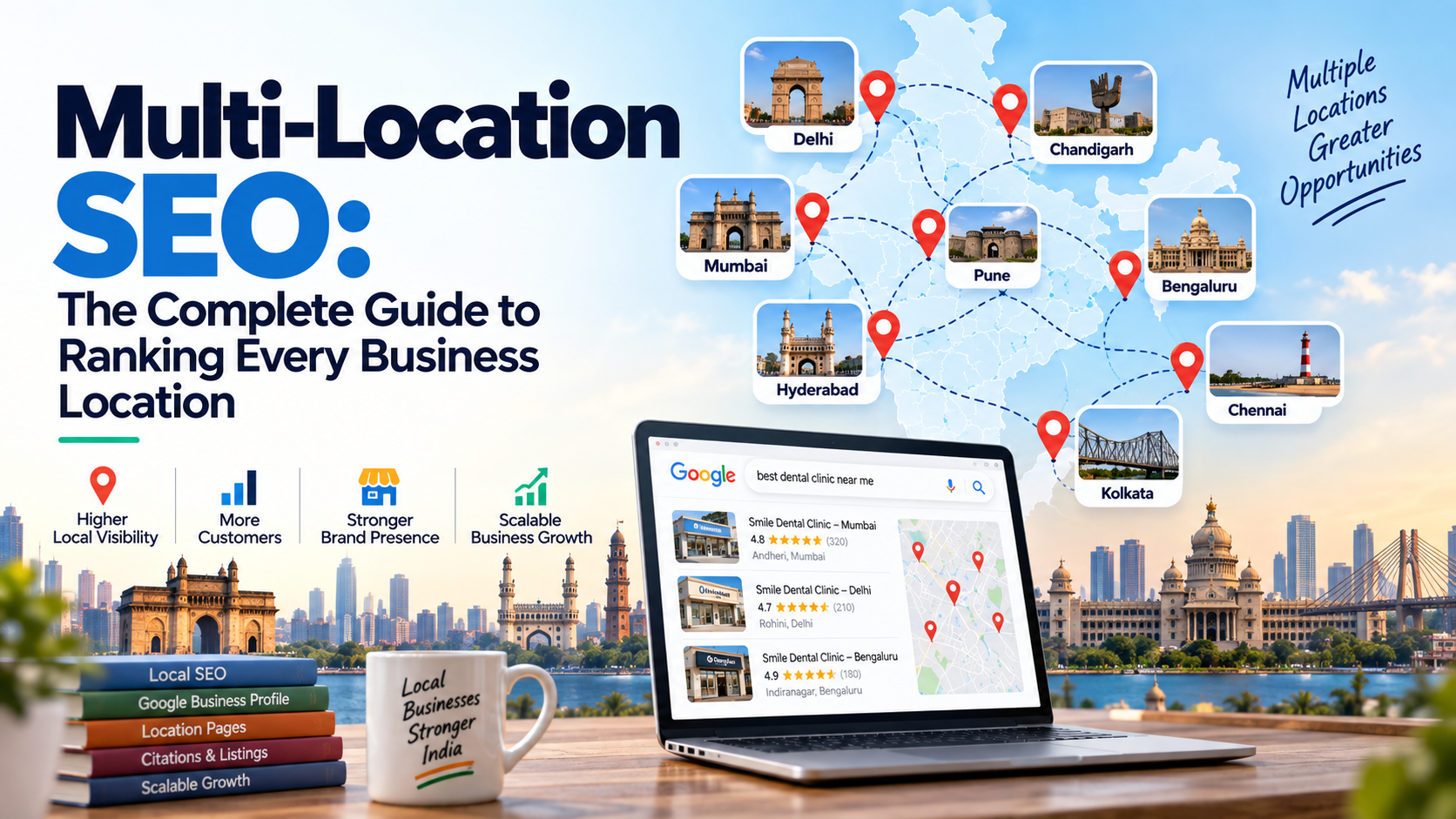
If your business operates out of five branches or five hundred, a single optimized homepage was never going to cut it. Multi-location SEO is the practice of making every physical branch, store, office, or clinic individually visible in Google Search and Google Maps — not just the corporate brand as a whole.
This is a fundamentally different job than traditional local SEO. A single-location business optimizes one address, one Google Business Profile, and one set of local signals. Local SEO for multiple locations means repeating that work correctly — and at scale — across dozens, hundreds, or thousands of markets, each with its own competitors, its own local search intent, and its own map coordinates.
The stakes are different too. Enterprise local SEO and franchise SEO programs are judged on location-specific rankings, not just domain-wide traffic. A regional manager doesn't care that the brand ranks nationally if their branch is invisible in the Local Pack for searches happening three miles from their front door.
This guide walks through what multi-location business SEO actually requires: the technical architecture, the operational systems, and the day-to-day workflows that keep hundreds of locations accurately represented in search. You'll find a full multi-location SEO checklist, a location page framework, a keyword-to-location mapping method, and an audit checklist you can run against your own program today.
The core idea to hold onto throughout: the goal isn't to rank one corporate website. The goal is to make each legitimate physical location discoverable for the people searching near it — matching customer proximity with search visibility, market by market.
What Is Multi-Location SEO?
Multi-location SEO is the discipline of optimizing search visibility for a business with more than one physical location, so that each branch ranks independently in its own local market rather than competing against — or diluting — the others.
It sits at the intersection of local SEO, technical SEO, and operations. A single misaligned address or an unclaimed listing at one branch doesn't just hurt that branch; it can distort how search engines interpret the entire brand's location data.
How Multi-Location SEO Works
At its core, multi-location SEO means repeating a proven local optimization framework — accurately and consistently — for every eligible physical location the business operates. That includes:
- Optimizing individual branches, not just the parent brand, as distinct local entities
- Claiming and maintaining a Google Business Profile for every eligible branch, store, office, or clinic
- Building dedicated location pages with real, local information
- Establishing accurate local citations across directories and data aggregators
- Targeting local keywords specific to each service area and local market
- Generating and managing reviews at the branch level
- Earning local backlinks tied to each location's geography
- Handling technical SEO — schema, sitemaps, crawlability — across a location-page architecture that can scale
- Producing genuinely location-specific content, not templated filler
The same framework applies whether the business runs brick-and-mortar branches (store, clinic, office) or operates as a franchise or service-area business covering a defined city, suburb, neighborhood, or postcode / ZIP code without a public storefront.
Why Multi-Location SEO Is Different From Traditional Local SEO
Single-location local SEO is a project. Multi-location local SEO is a system. The difference is complexity, multiplied by every branch you add.
Consider what has to be managed correctly, simultaneously, across the portfolio:
- Multiple Google Business Profiles, each requiring its own verification, categories, and updates
- Multiple addresses and multiple phone numbers, all of which must stay accurate as branches open, close, or relocate
- Multiple location pages, each needing unique, indexable content rather than a duplicated template
- Location-specific rankings that have to be tracked market by market, not averaged into one national number
- Reviews for individual branches, which live and die on local responsiveness, not brand-level reputation
- Citations that must be consistent across dozens of directories, for every single address
- Local backlinks earned at the geographic level, not just domain-wide authority
- Location-level reporting that ties search performance back to calls, bookings, and revenue per branch
This is exactly why enterprise local SEO and franchise SEO are treated as their own specialties. A ten-location regional chain and a thousand-location national franchise face the same categories of problems — they just face them at different orders of magnitude.
How Search Engines Determine Local Visibility
Google's local ranking systems weigh three primary factors: relevance, distance, and prominence. In practice, that breaks down into signals multi-location businesses can directly influence:
- Relevance — how well a listing or page matches what the searcher is looking for, based on categories, services, and location-specific information
- Proximity — how close the location is to the searcher (or to the location implied in their query), which is why customer proximity is central to local intent
- Local intent — whether the query itself signals a need for a nearby result, including explicit "near me" searches and implicit local queries like "emergency plumber" or "pediatric dentist"
These signals feed directly into what shows up in Google Maps, the Local Pack (the three-result map block on search results pages), and the Knowledge Panel for the brand or location. Because a majority of local queries now happen on mobile search, proximity signals carry even more weight — a searcher standing outside your competitor's block is a very different opportunity than one searching from another city.
Multi-Location SEO Checklist: The 10 Essential Steps
Before going deep into any single tactic, it helps to see the full multi-location SEO checklist at a glance. Each of the ten steps below gets its own detailed section further down this guide.
- Create and optimize every Google Business Profile — one accurate, verified listing per eligible location
- Maintain NAP consistency — name, address, and phone number identical everywhere they appear
- Build individual location pages — a dedicated, indexable page for every real branch
- Map keywords to locations — a service-by-city keyword matrix, not guesswork
- Create unique localized content — genuine local information, not a duplicated template
- Implement LocalBusiness schema — structured data that accurately describes each branch
- Build local citations — consistent listings across the directories that matter
- Generate and manage reviews — a repeatable process for every branch, not just headquarters
- Earn local backlinks — geographic authority from real community relationships
- Track performance by location — rankings, visibility, and revenue attribution, market by market
Treat this as your navigation map for the rest of the guide — and as the audit framework you'll return to once your program is live.
1. Optimize Google Business Profile for Every Location
Create a Google Business Profile for Each Eligible Location
Every legitimate branch that serves customers at a physical address, or within a defined service area, should have its own Google Business Profile. Forcing multiple locations into a single profile — a common shortcut for businesses trying to save time — actively suppresses Maps visibility for everywhere except the address Google associates with that one listing.
A location-specific GBP gives each branch its own entry point into Google Maps optimization: its own reviews, its own photos, its own local ranking signals. Treat verified business listing status as non-negotiable — an unverified profile is far less likely to surface in local results, and it's vulnerable to being edited or claimed by someone else.
Business profile management at scale usually means using Google's bulk location upload tools or a listings management platform rather than creating profiles one by one. Either way, the standard doesn't change: every eligible branch needs an accurate, individually verified presence.
Optimize Each Location's Business Profile
A claimed profile is only the starting point. Each one needs to be fully built out with location-specific detail:
- Business name — consistent with how the location is legally and publicly known, without keyword-stuffed additions
- Address — the precise, verifiable address of that branch or store
- Local phone number — a number that actually rings at that location, not a shared national line
- Business category — the most accurate primary category, plus relevant secondary categories
- Opening hours — kept current for regular operations
- Holiday hours — updated ahead of holidays, not after customers have already shown up to a locked door
- Services — the specific services offered at that branch, since service-area offerings can vary by location
- Photos — real images of that location, staff, and premises, not stock photography or images borrowed from another branch
- Website / branch URL — a direct link to that location's own page, not the generic homepage
Getting driving directions and geographic coordinates correct matters more than it might seem. An address that's technically correct but geocoded to the wrong point on the map can cause Google to show inaccurate directions or place the pin in the wrong neighborhood entirely.
Improve Google Maps and Local Pack Visibility
Once a profile is built out, visibility becomes an ongoing optimization effort rather than a one-time task. The levers that move a location up in the Local Pack and Map Pack include:
- Complete, accurate location-specific information across every profile field
- Steady review velocity (covered in detail later in this guide)
- Category accuracy relative to what searchers are actually looking for
- Consistent local rankings signals reinforced by citations and location pages
Search visibility in Maps compounds with customer proximity — a well-optimized profile close to the searcher will typically outperform a stronger brand located further away. That's precisely why "near me" searches reward local optimization over generic domain authority.
FAQ callout: Why does each business location need its own Google Business Profile? Answered in the FAQ section below.
2. Maintain NAP Consistency Across Every Location
What Is NAP Consistency?
NAP consistency means a location's name, address, and phone number appear identically everywhere they're listed — the website, Google Business Profile, directories, citations, and social platforms.
Search engines use matching NAP data as a trust signal for canonical business data. When the same details appear consistently across the web, it reinforces that a listing is accurate. When they don't — "St." in one place and "Street" in another, an old phone number still live on a directory — it introduces doubt that can suppress listing accuracy and rankings.
Create a Single Source of Truth for Business Data
At multi-location scale, NAP consistency isn't something you can manage by memory or spreadsheet edits made in three different places. It requires a centralized dashboard functioning as the single source of truth for every location's data.
A well-built location database should capture, per branch:
- Location name
- Address
- Phone number
- Branch URL
- Opening hours
- Holiday hours
- Services offered
- Geographic coordinates
- Business category
Every downstream system — the website's location pages, the Google Business Profile, third-party directories — should pull from this canonical business data, not be updated independently. This is one of the three assets worth building alongside this guide: a Master NAP Data Sheet Template that scales cleanly whether you're managing ten locations or a thousand.
Listing synchronization tools can push updates from this single source out to major directories automatically, which removes the manual re-entry that causes inconsistency in the first place.
Audit Citations and Business Listings
A citation audit means systematically checking how your business is represented across every directory listing and data aggregator that matters to your industry and geography. At minimum, that includes:
- Yelp
- Apple Maps
- Bing Places
- Relevant industry directories specific to your sector
Citation cleanup is ongoing work, not a one-time project — locations relocate, phone numbers change, and franchisees sometimes create their own unauthorized listings. Regular listing management catches these before they compound into ranking problems.
Find and Fix Duplicate Listings
Duplicate listings happen constantly at multi-location scale: a location gets re-created after a rebrand, a franchisee claims a listing separately from corporate, or an old address generates a second profile after a move.
A structured cleanup process should:
- Search for the business name plus each address to surface duplicate profiles
- Confirm which listing is verified and accurately reflects the current location
- Use each platform's process for claiming listings and requesting verification on the correct one
- Flag listings with incorrect business information for correction rather than deletion, where the listing itself is legitimate
- Request merging or removing duplicates through the platform's official reporting tools
Duplicate Google Business Profiles are particularly damaging because they split reviews, split local ranking signals, and confuse customers trying to find the right branch.
3. Build a Scalable Location Page Architecture
Does Every Location Need Its Own Page?
Every real, operating branch should have its own dedicated, indexable location page — a single canonical destination that represents that address online. This is the foundation of good local landing pages strategy: one real location, one page, no exceptions.
What you should avoid is the inverse: creating pages for cities or neighborhoods where the business has no legitimate physical or service presence, purely to chase search volume. Search engines have gotten considerably better at detecting location pages built around a place the business doesn't actually serve, and this kind of thin, unsupported page tends to drag down the credibility of the entire location directory.
Create a Scalable URL Structure
A scalable URL structure should mirror how customers actually think about your locations — usually region, then city, then neighborhood or branch. A common pattern:
/locations/
/locations/mumbai/
/locations/mumbai/andheri/
For a national franchise, that might extend to a state or region layer first. For a smaller multi-city operator, a flatter structure — /locations/city-name/ — may be all that's needed. The right location page template depends on how many branches exist within each city or region, but the underlying principle stays the same: the URL itself should communicate geography clearly, both to users and to search engines.
Build a Location Directory and Store Locator
A location directory — often paired with a store locator tool — is the connective layer between the corporate site and every individual branch URL. It should let a visitor move naturally from:
- Corporate homepage → region or city page → individual branch page
Each level should link both down (to child locations) and across (to related locations nearby), so the internal linking structure reinforces geographic relevance throughout the site rather than isolating each location page as an orphaned URL.
What Should a Multi-Location Landing Page Include?
This is where most multi-location programs either win or lose the search visibility battle — the individual page has to earn its ranking on its own merits. A strong page includes:
- Local NAP details displayed prominently, matching the centralized data source exactly
- Opening hours, including current holiday adjustments
- An embedded map for immediate visual orientation
- Driving directions or a direct link to navigation
- Services available specifically at that branch
- Unique local copy describing the location, its market, and what it offers
- Real location photos, not stock imagery
- Local testimonials from actual customers of that branch
- Staff profiles, where relevant to the business type
- Nearby landmarks that help with orientation and local relevance
- Local offers or promotions specific to that market
- Community events the branch participates in or sponsors
- Area-specific FAQs addressing questions unique to that location
- Internal links to related locations, service pages, and the location directory
Not every element applies to every business — a service-area business without a public storefront will lean more on service area description and coverage than on staff profiles or landmarks. The underlying test is the same: does this page tell a genuinely local story, or could it be dropped onto any city with a find-and-replace?
4. Conduct Local Keyword Research for Every Location
Identify Location-Specific Search Terms
Local keywords extend far beyond "[service] + [city]." A complete location-specific keyword set typically spans several formats:
- Geographic keywords — service plus city, suburb, or region
- Neighborhood keywords — service plus a specific local area, useful in dense urban markets
- Postcode keywords — relevant in markets where searchers reference ZIP or postal codes directly
- "Near me" keywords — proximity-driven queries that assume the searcher's current location
Map Services to Cities, Neighborhoods, and Locations
The single most useful workaround to keyword gaps and overlap at scale is a keyword-to-location matrix — mapping every service against every city, suburb, or branch the business serves. A simple version looks like this:
| Service | Location | Primary Keyword |
|---|---|---|
| Service A | Mumbai | Service A Mumbai |
| Service A | Andheri | Service A Andheri |
| Service B | Pune | Service B Pune |
Building this out fully, for every service and every location, does two things at once. It surfaces gaps — services with no local keyword targeting anywhere — and it prevents keyword cannibalization, where two location pages end up competing against each other for the same term instead of each owning a distinct geographic slice.
Match Keywords to Local Search Intent
Not every geographic keyword deserves equal priority. Terms should be weighted by how strongly they signal:
- Local purchase intent — the searcher is close to booking or buying
- Service availability — confirming the business offers a specific service in their area
- Geographic intent — a clear location qualifier in the query itself
- Proximity intent and "near me" intent — the searcher wants the closest viable option, not necessarily the best-known brand
A location page built around low-intent, purely informational keywords will rarely outperform a page built around terms that map directly to a searcher ready to act.
Where Should Local Keywords Appear?
Once the matrix is built, keywords need to be placed deliberately — not stuffed, but present where both users and search engines expect to find them:
- Title tags
- Meta descriptions
- H1 headings
- H2/H3 subheadings
- Body copy, in natural, readable sentences
- Service descriptions specific to that branch
- Image alt text
- Internal anchors linking to and from the page
- URL slugs
- Local FAQs addressing area-specific questions
The guiding rule: every geographic term on the page should correspond to something genuinely true and locally relevant. A neighborhood mentioned in a heading should also show up somewhere in the page's actual local content — landmarks, service coverage, or testimonials — not appear only because it was pulled from a keyword list.
5. Create Unique, Localized Content for Every Location
Avoid Duplicate Location Pages
Duplicate content is one of the most common failure points in multi-location programs, especially ones built quickly across hundreds of branches. The fix isn't to abandon templates — it's to separate reusable template structure from duplicated page content.
A shared layout, shared components, and a consistent design system are fine, and honestly necessary at scale. What can't be shared is the actual copy: the description of the location, its services, its community context. Unique location content is what tells search engines — and customers — that a page represents a real, distinct place.
Add Genuine Local Information
The strongest location pages read like they were written by someone who has actually been to that branch. That means including:
- Location-specific services, reflecting what's genuinely offered there
- Local testimonials from real customers of that specific location
- Staff profiles, where appropriate to the business
- Original location photos
- Nearby landmarks for orientation and local color
- Community events the location has participated in
- Local offers relevant to that market
- Area-specific FAQs
- A clear statement of service availability and a genuine location description
None of this needs to be lengthy. A few well-written, specific paragraphs will outperform a thousand words of generic, interchangeable copy every time.
Optimize On-Page Elements
Every location page needs its own fully optimized on-page foundation:
- Unique title tag
- Unique meta description
- Location-specific H1 heading
- A relevant, geography-reflecting URL slug
- Appropriate canonical tag — self-referencing for a genuine, unique location page
- Contextual internal linking to nearby locations and relevant service pages
Skipping any one of these — especially reusing the same title tag or meta description across multiple branches — signals to search engines that the pages are interchangeable, which undermines the very differentiation you're trying to build.
Strengthen Internal Linking Between Locations
Internal links do double duty for multi-location sites: they help users navigate between branches, and they distribute ranking signals across the location network. Strong internal linking connects:
- Related locations nearby
- Relevant service pages
- Parent city pages
- The overall location directory
- The store locator
- Corporate or brand-level service pages
A location page that links only up to the homepage, with nothing connecting it sideways to nearby branches, is leaving an easy source of relevance and crawl efficiency on the table.
6. Implement LocalBusiness Schema and Technical SEO
Add LocalBusiness Structured Data
LocalBusiness schema gives search engines an explicit, machine-readable description of each location, rather than asking them to infer details from page copy. Implemented well, this structured data should include:
- PostalAddress — the full, accurate street address
- GeoCoordinates — precise latitude and longitude
- OpeningHoursSpecification — regular hours, structured correctly by day
- Business category and name
- Services offered at that location
- Aggregate review data, where genuinely available
The rule that matters most here: only mark up information that's actually true and present on the page. Schema is meant to describe real content, not to manufacture credibility that the visible page doesn't back up.
Validate Location Schema
Every location page's schema markup should go through schema validation before and after launch — Google's Rich Results Test is the standard tool for this. Validation catches structural errors (a missing required property, a malformed date format) before they prevent rich snippets from appearing at all.
This should be built into the location page template's QA process, not treated as a one-time check. A template change that accidentally breaks schema on one page usually breaks it on every page built from that template.
Make Every Location Page Technically Crawlable
A perfectly optimized location page delivers zero value if search engines can't reach or index it. Run every location page through this technical checklist:
- Indexable — not accidentally set to
noindex - Canonicalized correctly — pointing to itself, not to another location or the homepage
- Included in the appropriate XML sitemap
- Mobile responsiveness confirmed on real devices, not just a browser resize
- Page speed within acceptable thresholds
- Crawlability confirmed — no broken internal links or orphaned pages
- Internally linked from at least the location directory and one related page
- Not accidentally blocked by
robots.txt, at either the page or the pattern level
At scale, a single misconfigured template rule — a wildcard noindex tag, a sitemap generator that silently drops new locations — can quietly remove hundreds of pages from search without anyone noticing until rankings drop.
7. Build Local Citations and Directory Authority
Prioritize Major Local and Mapping Platforms
Citation building for multi-location businesses should start with the local citations and business listings that carry the most authority and the widest reach:
- Apple Maps
- Bing Places
- Yelp
- Foursquare
These platforms feed data aggregators and influence how consistently your directory listings appear across the wider web, which is why getting them right first has an outsized effect on everything downstream.
Build Industry-Specific and Local Citations
Beyond the majors, relevance matters more than raw volume. Worthwhile citation sources include:
- Local directories specific to each city or region
- Industry directories relevant to your specific sector
- Business associations your locations belong to
- Community organizations with an online directory presence
A citation from a respected local chamber directory, tied to a real membership, is worth considerably more than a dozen citations from low-quality, unmoderated listing sites.
Keep Listings Synchronized
Citations decay. Addresses change, phone numbers get reassigned, and franchisees occasionally update one listing without touching the rest. Keeping them synchronized requires:
- Working with data aggregators that distribute updates to downstream directories automatically
- Using listing synchronization tools tied back to the single source of truth
- Running periodic citation cleanup passes rather than a single one-time fix
- Auditing listing accuracy on a fixed schedule, not only when a problem is reported
8. Build Reviews and Reputation for Every Location
Create a Scalable Review Generation Process
Online reviews are one of the strongest local trust and ranking signals available, and they need to be earned consistently across every branch — not just the flagship location. A scalable review generation process typically includes:
- An automated review request sent after a completed transaction or service visit
- A simple, low-friction path to leaving a review (a direct link, a QR code at the point of service)
- A consistent cadence applied at every location, so review volume and review velocity don't vary wildly by branch
- Staff training so every location understands its role in the process
Locations with a steady flow of recent reviews and strong ratings consistently outperform locations with a handful of reviews from years ago, even when the underlying business quality is comparable.
Respond to Positive and Negative Reviews
Review management doesn't stop at collection — it extends into how the business responds. Effective review responses should be:
- Timely — ideally within a few days, not weeks
- Authentic — written by someone who understands that specific location, not a copy-pasted script
- Location-specific — referencing the actual branch, not a generic corporate line
- Genuinely helpful, especially for a negative review response
- Consistent with the overall brand voice, even when handled by local staff
A well-handled negative review, addressed with real customer feedback and a clear resolution path, often does more for trust than another five-star review would.
Turn Reviews Into Local Proof
Reviews shouldn't live only on the Google Business Profile. Where appropriate, genuine customer feedback belongs on the location page itself, functioning as local proof of customer experience.
Trust signals built from real, attributed testimonials carry far more weight than generic marketing copy — and authenticity is exactly what separates a location page that converts from one that reads like every other page on the site.
9. Build Local Backlinks and Geographic Authority
Earn Links From Local Organizations
Local link building is about earning geographic authority for each individual branch, not just accumulating domain-wide backlink volume. Strong local sources include:
- Chamber of Commerce membership directories
- Local partnerships with complementary businesses
- Community links from local organizations the branch supports
A single relevant link from a real local organization tends to outperform dozens of generic, low-relevance directory links.
Leverage Local News, Events, and Sponsorships
Local visibility off-site compounds local visibility on search. Worthwhile avenues include:
- Coverage from local news outlets covering community happenings
- Participation with community organizations
- Sponsorships of local teams, charities, or causes
- Involvement in local events that generate organic coverage
- Membership in relevant business associations
Build Location-Level Partnerships
Partnerships work best when they're genuinely reciprocal and locally grounded. Consider:
- Nearby local businesses in complementary categories
- Industry partners operating in the same market
- Community organizations with an active local presence
- Local associations relevant to the industry
- Event organizers running relevant local events
The throughline across all local link building: prioritize relevant geographic authority tied to a real relationship, rather than chasing link volume for its own sake.
10. Track SEO Performance at the Location Level
Track Local Rankings by Geography
National or brand-wide average rankings hide exactly the information a multi-location business needs. A term ranking #2 in one city and #14 in another averages out to a number that tells you almost nothing actionable.
Geo-grid rank tracking solves this by measuring local rankings from multiple points around each location, revealing how visibility actually shifts across a service area rather than from one single central point. Pair this with ongoing competitor analysis at the local level — the competitor ranking above you in one city may be entirely different from the one ranking above you in the next.
Monitor Google Search Console and Location-Level Visibility
Google Search Console data should be segmented wherever the platform's structure allows, so search visibility can be evaluated by:
- Location
- City
- Service
- Query
- Device
Establishing baseline metrics before a program launches — or before a major site change — is what makes later performance conversations meaningful. Without a baseline, "traffic is up" or "rankings improved" has no reference point.
Measure Local Actions and Conversions
Rankings and impressions are leading indicators. What actually matters to the business are the actions they produce:
- Calls
- Direction requests
- Website clicks
- Bookings
- Leads
- Foot traffic
- Conversions
- Revenue attribution
Google Business Profile insights, call tracking numbers, and location-page conversion tracking should all feed into a single location-level view, rather than living in three disconnected dashboards.
Calculate ROI by Location
The full value chain for multi-location SEO runs: search visibility → local action → lead or customer → revenue. Calculating ROI by location means connecting each step of that chain back to a specific branch, so investment decisions can be made market by market rather than for the brand as a whole.
This is also where underperforming locations get identified early — a branch with strong visibility but weak conversion may have a very different problem than a branch with weak visibility to begin with.
Establish a Multi-Location SEO Reporting Cadence
A fixed reporting cadence, tied back to the same baseline metrics every time, keeps a multi-location program accountable. Regular reports should cover:
- Rankings, by location
- GBP performance
- Calls
- Direction requests
- Website clicks
- Leads and bookings
- Revenue, where attribution allows
Monthly reporting is typical for most programs, with a lighter weekly pulse-check on rankings and GBP health for locations undergoing active optimization work.
Multi-Location SEO Audit Checklist
Use this as a working checklist across your location portfolio — the third asset worth building alongside this guide is a live, spreadsheet version of this framework, scored per location.
Google Business Profile
- Every eligible location has the correct GBP
- Profiles are verified
- Location information is accurate
- Categories are appropriate
- Hours are current
- Photos are location-specific
- Branch URL is correct
Location Pages
- Every real location has a dedicated page
- Pages are indexable
- Content is unique
- NAP is visible
- Map is included
- Directions are available
- Services are location-specific
- Internal links are present
NAP & Citations
- Name is consistent
- Address is consistent
- Phone is consistent
- Major directories are accurate
- Duplicate listings are resolved
On-Page & Technical
- Title tags optimized
- Meta descriptions optimized
- H1s localized
- URLs structured logically
- Canonicals correct
- LocalBusiness schema implemented
- XML sitemap updated
- Mobile experience optimized
- Pages crawlable
Reputation
- Review generation process exists
- Reviews monitored
- Reviews answered
- Negative feedback handled appropriately
Authority
- Local backlinks acquired
- Community relationships developed
- Local events/sponsorship opportunities explored
Measurement
- Geo-grid tracking configured
- Location rankings tracked
- Calls tracked
- Directions tracked
- Leads/bookings tracked
- Revenue attribution considered
Multi-Location SEO FAQs
What is multi-location SEO?
Multi-location SEO is the practice of optimizing search visibility for every physical branch a business operates, so each location ranks independently in its own local market rather than relying solely on brand-wide authority. It combines Google Business Profile management, location pages, citations, reviews, and technical SEO applied consistently across the entire portfolio.
Why does each business location need its own Google Business Profile?
Each Google Business Profile carries its own local ranking signals — reviews, photos, categories, and proximity data tied to a specific address. Consolidating multiple branches into one profile suppresses Maps visibility everywhere except the single address Google associates with that listing, so separate, verified profiles are essential for accurate local rankings at every branch.
Does every location need its own website page?
Yes — every legitimate, operating location should have its own dedicated, indexable location page. The exception is locations with no genuine physical or service presence; creating pages for markets the business doesn't actually serve tends to weaken the credibility of the whole location directory rather than expand its reach.
What should a multi-location landing page include?
A strong location page includes local NAP details, current hours, an embedded map, driving directions, location-specific services, unique local copy, real photos, local testimonials, nearby landmarks, and area-specific FAQs. The common thread across all of it: genuinely local information rather than templated text with the city name swapped in.
How do I avoid duplicate content across location pages?
Separate the reusable template — layout, design, page structure — from the actual written content, which must be unique per location. Each page needs its own description, its own testimonials, its own services list, and its own title tag and meta description; sharing the frame is fine, sharing the copy is not.
What is NAP consistency, and why does it matter?
NAP consistency means a location's name, address, and phone number appear identically across the website, Google Business Profile, and every directory listing. Search engines treat matching data as a trust signal for canonical business data — inconsistent NAP introduces doubt that can suppress rankings and confuse customers trying to find the right branch.
Which business directories matter for multi-location SEO?
Apple Maps, Bing, and Yelp typically matter most across almost every industry, alongside relevant industry directories and local business associations specific to your sector. Prioritize accuracy and relevance on these before expanding into smaller, niche listing sites.
How do I find and fix duplicate business listings?
Search each platform for the business name paired with every known address to surface duplicates, then confirm which listing is verified and accurate. Use each platform's official claiming and verification process on the correct listing, and request merging or removal of the duplicate through that platform's reporting tools rather than simply abandoning it.
Which keywords should each location target?
Build a keyword-to-location matrix mapping every service against every city, suburb, or branch — including geographic keywords, neighborhood keywords, postcode keywords, and "near me" variations. This surfaces coverage gaps and prevents multiple location pages from competing for the same term.
Where should local keywords appear on a location page?
Local keywords should appear naturally in title tags, meta descriptions, H1 and H2 headings, body copy, service descriptions, image alt text, internal anchor text, URL slugs, and area-specific FAQs. Every geographic term used should correspond to something genuinely true about that location — not be inserted purely for keyword count.
What schema markup should a location page use?
LocalBusiness schema is the standard, including PostalAddress, GeoCoordinates, and OpeningHoursSpecification properties. Validate every implementation with Google's Rich Results Test, and only mark up information that's accurate and genuinely present on the page.
How important are reviews for multi-location SEO?
Reviews are one of the strongest local ranking and trust signals available, and they need to be earned consistently at every branch — not concentrated at a flagship location. Steady review volume, quick review responses, and well-handled negative feedback all directly influence a location's visibility and conversion rate.
How can a business earn local backlinks for every branch?
Focus on geographic authority over volume: Chamber of Commerce memberships, local news coverage, sponsorships, community event participation, and partnerships with nearby complementary businesses. A single relevant local link consistently outperforms a large batch of generic, low-relevance directory links.
How do you track SEO performance for multiple locations?
Use geo-grid rank tracking to measure local rankings from multiple points around each location, segment Google Search Console data by location and query, and connect calls, direction requests, bookings, and leads back to individual branches. This location-level view is what allows ROI by location to actually be calculated.
How often should multi-location SEO listings and pages be audited?
A full audit — covering GBP accuracy, NAP consistency, citations, and location page health — is typically worth running quarterly, with lighter monthly checks on rankings, reviews, and GBP performance for locations under active optimization. Any time a location opens, closes, relocates, or rebrands, an audit of that specific branch should happen immediately rather than waiting for the next scheduled cycle.
Interested in what this covers? Explore our Local SEO service.
Learn More