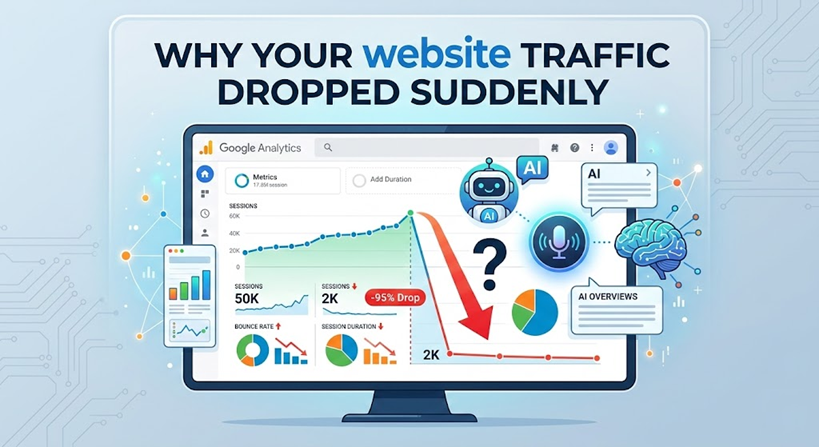
If your website traffic dropped suddenly in 2026, you are not alone.
Across industries, businesses have reported a significant drop in website traffic, sometimes as high as 20–60% compared to previous years. For many companies, this drop seems sudden and confusing.
Common reactions include:
-
Why has my website traffic dropped?
-
Why did my Google organic traffic suddenly decline?
-
Did Google penalize my website?
-
Is SEO no longer effective?
The reality is that search behaviour and search technology have changed dramatically.
In 2026, Google and other search engines are increasingly powered by AI-driven search systems that provide direct answers on the results page. Instead of simply listing websites, search engines now summarize information, compare options, and generate recommendations instantly.
This transformation has significantly affected how websites receive traffic.
In this guide, we’ll explain why your Google search traffic dropped, how to diagnose the problem, and what you can do to recover lost website traffic in the AI search era.
Why Has My Website Traffic Dropped Suddenly?
A sudden drop in website traffic usually occurs due to changes in Google’s algorithm, technical SEO issues, AI-generated search results reducing clicks, or increased competition.
In 2026, many websites also experience traffic loss because AI-powered search results answer questions directly on the search page, reducing the need for users to click through to websites.
The most common causes include:
-
AI search overviews reducing click-through rates
-
Google algorithm updates
-
Thin or outdated content
-
Technical SEO issues
-
Website redesign mistakes
-
Loss of backlinks or authority
Understanding the root cause is the first step toward solving a Google search traffic drop.
What Causes a Sudden Drop in Website Traffic?
Traffic fluctuations are normal in SEO, but a significant or long-term decline usually indicates deeper issues.
Several factors can contribute to a drop in website traffic, including:
-
Changes in search engine algorithms
-
Reduced click-through rates due to AI answers
-
Increased competition in search results
-
Technical problems affecting indexing
-
Content losing relevance over time
Identifying the correct cause is critical before implementing recovery strategies.
How AI Search Changed Organic Traffic in 2026
One of the biggest reasons businesses have seen a Google organic traffic drop is the rapid rise of AI-powered search results.
Search engines now use advanced artificial intelligence to generate summaries directly in the results page through features such as:
-
AI Overviews
-
Zero-click search results
-
Conversational search responses
-
Context-aware recommendations
Instead of presenting only links, search engines now compile answers from multiple sources and display them instantly.
While this improves the user experience, it also means fewer users need to visit websites to get the information they want.
As a result, many businesses are experiencing a drop in website traffic even when their rankings remain stable.
1. AI Overviews Reduced Click-Through Rates
AI-generated summaries are now appearing above traditional search results.
For example, when users search queries like:
-
“Why has my website traffic dropped”
-
“How to increase website traffic”
-
“SEO strategies for 2026”
Search engines often display a detailed AI-generated explanation before listing websites.
This leads to:
-
Stable keyword rankings
-
Similar impressions
-
But fewer clicks to websites
Many businesses therefore notice a Google search traffic drop even though their rankings haven’t changed significantly.
2. Informational Content Lost Search Volume
Another reason for a sudden drop in website traffic is the decline of traditional informational searches.
Previously, blogs targeting questions like:
-
What is SEO
-
What is digital marketing
-
How to increase website traffic
could generate significant traffic.
However, AI search engines now answer many of these questions instantly.
As a result, informational searches generate fewer clicks than before.
This doesn’t mean blogs are useless — they still help build authority — but relying only on informational traffic can result in declining organic visits.
3. Low-Authority Websites Lost Visibility
Search engines increasingly prioritize trusted and authoritative websites.
AI search systems tend to reference sources that demonstrate:
-
Strong expertise
-
Reliable backlinks
-
Established brand authority
-
Comprehensive topic coverage
-
Consistent publishing history
If a website lacks these signals, it may struggle to appear prominently in search results.
This shift toward Experience, Expertise, Authority, and Trust (E-E-A-T) has caused many smaller websites to experience a Google organic traffic drop.
4. Thin Content No Longer Ranks
Publishing large volumes of generic blog posts used to be a common SEO strategy.
However, search engines have become far more sophisticated at identifying low-value content.
Content that simply repeats commonly available information without offering new insights is less likely to rank.
Examples of thin content include:
-
Generic AI-generated articles
-
Surface-level explanations
-
Rewritten information without added value
-
Content lacking real expertise
Search engines now prioritize depth, originality, and expertise.
Websites relying heavily on low-quality or repetitive content often experience a drop in organic traffic.
5. Website Redesign or Technical SEO Issues
Sometimes the cause of a Google search traffic drop is purely technical.
A website redesign traffic drop is one of the most common SEO problems when migrations are handled incorrectly.
Technical issues that can reduce traffic include:
-
Broken redirects
-
Incorrect URL changes
-
Missing metadata
-
Indexing problems
-
Slow page speed
-
Blocked pages in robots.txt
Many businesses discover a Google Analytics sudden drop in traffic shortly after launching a new website.
Regular technical SEO audits can help prevent these issues.
Quick Diagnosis: Why Your Website Traffic Dropped
| Problem | How to Check | Solution |
|---|---|---|
| AI search results reducing clicks | Compare impressions vs clicks in Search Console | Optimize for AI search summaries |
| Algorithm update | Check timing of traffic drop | Improve content quality |
| Technical SEO issue | Run site audit | Fix indexing or redirects |
| Weak content | Compare with competitors | Improve depth and originality |
| Website redesign problems | Check redirects and URLs | Fix migration issues |
Structured diagnostics like this help identify the exact cause of a drop in website traffic.
How to Diagnose a Google Search Traffic Drop
Before trying to recover lost traffic, you must determine why the decline happened.
Check Google Search Console
Look for:
-
Changes in impressions
-
Keyword ranking shifts
-
Pages losing visibility
This helps determine whether the issue is related to rankings or click-through rates.
Analyze Google Analytics Data
Identify whether the traffic drop affects:
-
Specific pages
-
Entire sections of the site
-
Particular traffic channels
This helps narrow down the cause.
Review Algorithm Updates
Major algorithm updates often affect content quality, authority signals, and user experience factors.
If the traffic drop aligns with an update, improving content quality is often the solution.
How to Recover Lost Website Traffic
Recovering from a Google search traffic drop requires a strategic SEO approach.
Here are the most effective recovery strategies.
Improve Content Depth and Quality
Modern SEO rewards expert-driven, comprehensive content.
Instead of publishing dozens of short articles, focus on creating high-value resources that thoroughly cover a topic.
Include:
-
Real examples
-
Data and statistics
-
Expert insights
-
Detailed explanations
High-quality content is more likely to be referenced by AI search systems.
Build Topical Authority
Search engines prefer websites that demonstrate deep expertise in specific topics.
Instead of isolated blog posts, create topic clusters covering related subjects.
For example:
-
SEO strategies
-
technical SEO audits
-
AI search optimization
-
organic traffic growth
-
website performance
This ecosystem of content strengthens authority and improves ranking potential.
Target High-Intent Keywords
Informational traffic may decline, but commercial and transactional searches remain highly valuable.
Examples include:
-
SEO services pricing
-
digital marketing agency services
-
technical SEO audit services
-
increase organic website traffic
These keywords attract users who are closer to making a decision.
Strengthen Backlinks and Brand Authority
Backlinks remain one of the strongest ranking factors.
Effective backlink strategies include:
-
digital PR campaigns
-
publishing original research
-
guest posting on industry websites
-
thought leadership content
Stronger brand authority increases the likelihood that AI search engines will reference your content.
How to Optimize Content for AI Search in 2026
As AI-driven search results become more common, websites must adapt their SEO strategy.
To improve visibility in AI search systems:
Use clear content structure
Short paragraphs and well-defined headings help AI extract information easily.
Answer questions directly
Concise answers improve the chances of appearing in AI summaries.
Add structured sections like tables and FAQs
These elements help search engines understand your content.
Include original insights
Unique perspectives increase credibility.
Build brand trust
AI search systems prioritize reliable sources.
Businesses that adapt their content strategy for AI search will gain a major competitive advantage.
Action Plan to Recover Website Traffic
If your website traffic dropped suddenly, follow this recovery checklist:
✔ Analyze Google Search Console data
✔ Identify pages losing impressions
✔ Improve content quality and depth
✔ Add structured headings and FAQs
✔ Strengthen internal linking
✔ Build high-quality backlinks
✔ Fix technical SEO issues
✔ Update outdated blog posts
✔ Optimize content for AI-driven search
Consistent improvements over several months can restore lost organic visibility.
The Future of SEO in the AI Search Era
SEO is evolving — not disappearing.
Instead of focusing only on traffic volume, successful businesses now focus on:
-
brand authority
-
expert content
-
topical depth
-
user value
Websites that provide high-quality, trustworthy information will continue to perform well in search results.
AI search is not the end of SEO — it is simply raising the standards for content quality and authority.
FAQs
Why has my website traffic dropped suddenly?
A sudden drop in website traffic may be caused by algorithm updates, AI search changes, technical SEO issues, or increased competition.
Why is my Google traffic dropping?
Google traffic can decline when click-through rates drop due to AI summaries, content loses relevance, or competitors improve their SEO.
How can I check a drop in organic traffic?
Use Google Search Console and Google Analytics to analyze impressions, keyword rankings, and traffic trends.
Can lost website traffic be recovered?
Yes. Improving content quality, strengthening authority, fixing technical issues, and optimizing for AI search can restore organic traffic.
How long does SEO recovery take?
Depending on the cause, recovery typically takes 3–6 months after implementing improvements.
Ready to Recover Your Website Traffic?
If your business is experiencing a Google search traffic drop, the right SEO strategy can help restore visibility and attract high-quality visitors.
At Cognidigit, we help businesses:
-
diagnose traffic loss
-
fix technical SEO problems
-
build topical authority
-
optimize content for AI search
-
increase sustainable organic traffic
Contact our team today to build a future-ready SEO strategy that drives long-term growth.