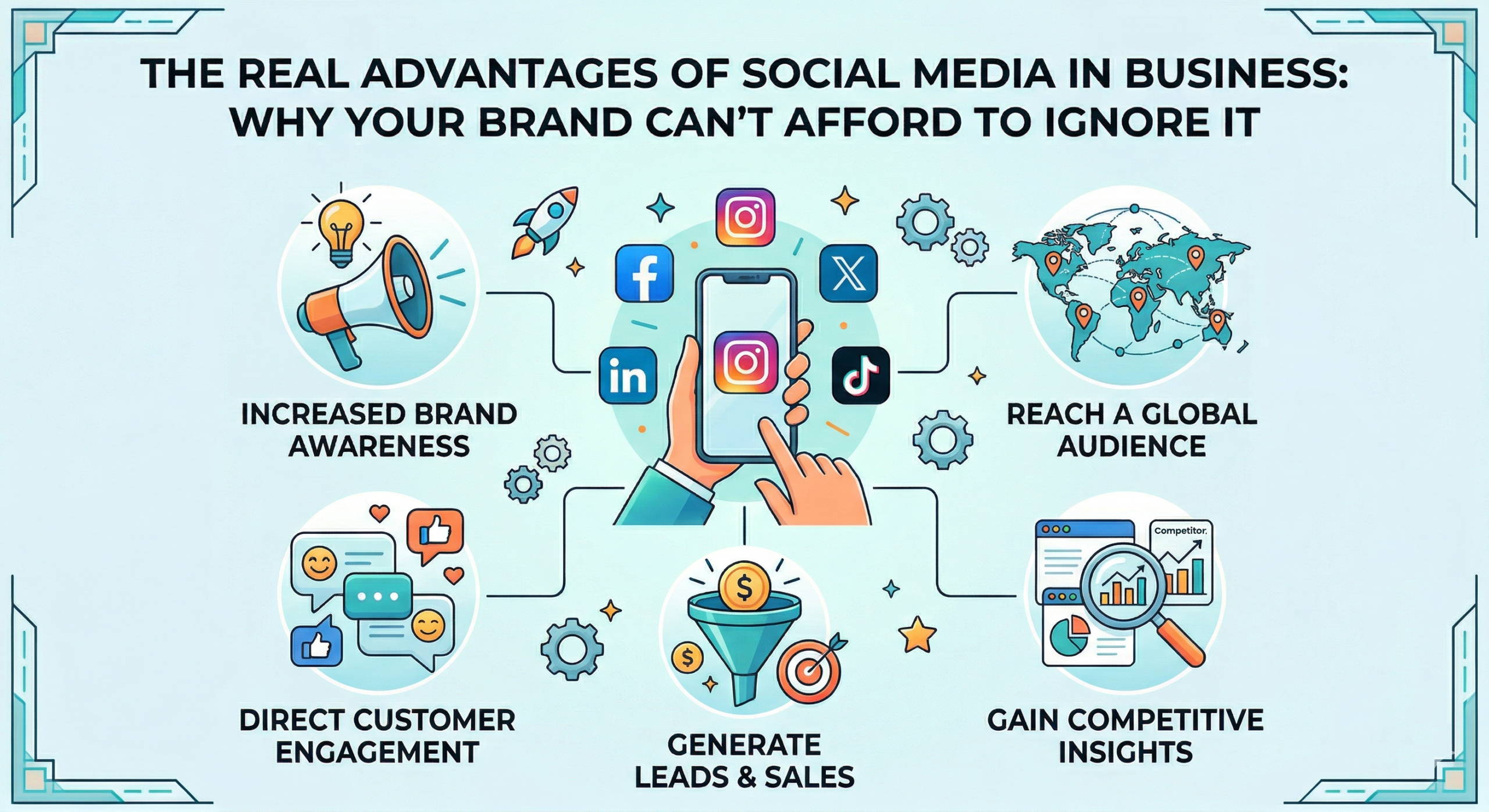
Understanding the advantages of social media in business starts with one striking fact: approximately 5.31 billion people across the globe are active on social media, representing 64.7% of the total global population. Given that social media platforms have become primary destinations for product research and purchasing decisions, the benefits of social media for business extend far beyond simple brand visibility. In fact, 63% of social media users follow companies, brands, and products, making social media marketing importance impossible to ignore. We’ll explore why social media is important for business today, the core benefits it delivers for growth, specific marketing advantages, and the competitive edge it provides to businesses ready to commit to a strategic social presence.
Why Social Media is Important for Business Today
The Scale of Social Media Usage Worldwide
Social platforms have evolved into mandatory business channels, with 5.66 billion active users worldwide representing 69.9% of the global population [1]. More revealing is that 93.8% of internet users access social media monthly [1], making these platforms nearly universal among connected audiences. The growth continues at a pace that adds 7.8 new users every single second [1], translating to 259 million new users annually [1].
The average person doesn’t just casually browse one platform. Users actively engage with 6.75 different social platforms each month [1] and dedicate 2 hours and 21 minutes daily to social media [2]. When we calculate the collective time humanity spends on these platforms, it amounts to 15 billion hours consumed daily [1]. These aren’t fleeting interactions but sustained engagement where users form opinions, research purchases, and build relationships with brands.
Where Your Customers Actually Spend Their Time
Your target audience isn’t passively scrolling for entertainment. Research shows that 54% of users turn to social media specifically to research products before making purchasing decisions [3]. More striking is that 70% of consumers admit social media influences their buying choices [4], with platforms serving as primary discovery channels for new brands and products.
The customer journey now unfolds directly within social feeds. Notably, 76% of consumers check a brand’s social media presence before deciding to purchase [1]. Gen Z exemplifies this shift, with 70% making purchases on Instagram and 63% on TikTok [2]. Among this demographic, 60% have made impulse purchases directly through social platforms [2], while over half will buy based solely on an influencer’s review [2].
What Happens When Businesses Ignore Social Media
The consequences of social media absence are measurable and immediate. A study tracking 16 companies with over 100,000 followers that stopped posting revealed organic social media traffic dropped 94% within six months, accompanied by a 6% revenue decline [5]. That revenue dip doesn’t account for lost growth opportunities, as customers who discover brands through social media often become repeat buyers [5].
When potential customers land on inactive profiles, they question whether your business still operates [1]. Accordingly, your silence sends them directly to competitors who maintain active, visible presences. Sporadic activity or complete absence erodes trust before customers ever interact with your actual products or services.
Core Benefits of Social Media for Business Growth
Building Brand Awareness Through Consistent Presence
Consistent visibility across social platforms establishes your brand as recognizable and trustworthy. When you maintain a cohesive visual identity and post regularly, potential customers begin to recognize your brand at a glance. This recognition translates directly into purchasing behavior, with 76% of consumers reporting they’re more likely to buy from brands they follow on social media [6]. The most compelling evidence comes from analyzing posting frequency: brands that post consistently receive five times more engagement per post than those with irregular schedules.
Reaching New Audiences Beyond Traditional Marketing
Social media breaks through the limitations of traditional advertising by putting your brand in front of people who’ve never heard of you. On Instagram alone, 83% of users say they discover new products on the platform [7]. The amplification effect multiplies your reach when existing customers share content. Visual posts prove particularly effective, generating 40 times more shares than text-only content [8]. This organic sharing introduces your brand to entirely new networks without additional ad spend.
Engaging Directly With Your Customer Base
Two-way communication separates social media from broadcast channels. When you respond to comments, answer questions, and acknowledge feedback, customers feel valued rather than ignored. Speed matters here. Most customers expect responses the same day, ideally within a few hours [4]. These interactions build lasting relationships that drive loyalty. In fact, nearly 80% of consumers base buying decisions on a friend’s social media post [2], making each positive interaction a potential referral.
Driving Traffic to Your Website and Online Platforms
Social platforms function as direct pathways to your website. Social media drives 31% of all referral traffic [8], delivering visitors who’ve already expressed interest in your content. Each post with a clear call-to-action and link creates an opportunity for clicks. Users who research products on social media, representing 54% of social browsers [3], actively seek more information and are primed to visit your site when you provide relevant links in posts, bios, and ads.
Advantages of Social Media in Business Marketing
Cost-Effective Advertising Compared to Traditional Channels
Social media advertising eliminates the financial barriers that make traditional media prohibitively expensive for most businesses. Whereas a 30-second national TV commercial costs around INR 9,703,751.84 (not including production) [9], social platforms offer drastically lower entry points. Facebook’s average cost-per-click sits at INR 74.25, Instagram ranges from INR 33.75 to INR 59.07, and Pinterest delivers the lowest rates at INR 8.44 to INR 126.57 [9]. Research tracking recruitment costs found social media advertising nearly twice as cost-effective, with an odds ratio of 1.97 for acquiring participants per dollar spent compared to non-social methods [10]. Most businesses achieve a 5:1 revenue-to-ad-spend ratio [11], making these platforms financially accessible while delivering measurable returns.
Precise Targeting and Retargeting Capabilities
Targeting precision separates social advertising from traditional channels that cast wide, unfocused nets. Platforms now use AI-driven algorithms that analyze behavioral patterns and preferences to predict customer intent [12]. You can segment audiences by demographics, interests, online behaviors, and past brand interactions [13]. Retargeting takes this further by installing tracking pixels on your website that monitor visitor actions, then serve relevant ads to those users on social platforms [14]. This approach proves particularly effective for converting interested browsers into buyers, as users have already demonstrated intent through their website visit.
Measuring Campaign Performance in Real Time
Real-time analytics remove the guesswork from marketing decisions. Social platforms provide instant feedback on impressions, engagement rates, click-through rates, and conversions [11]. You can track which audience segments respond best by monitoring cost-per-click and conversion metrics continuously [12]. This immediate visibility allows quick adjustments to targeting parameters, creative elements, and budget allocation without waiting weeks for results [9]. A/B testing becomes effortless, giving you concrete data on which messaging and visuals perform better [14].
Leveraging User-Generated Content and Social Proof
Customer-created content delivers authenticity that polished brand campaigns cannot match. UGC increases engagement by 28% and can lift conversion rates by 100.6% when users interact with it [11]. More revealing, advertising based on user-generated content generates a 400% increase in click-through rates [15]. This happens because 93% of marketers report UGC performs better than branded content [15], and 90% of consumers want to see content from existing customers [15]. When potential buyers see real people using your products, trust builds faster than through any branded message.
Creating Shareable Content That Amplifies Your Reach
Content that triggers emotional responses spreads organically, multiplying your reach without additional spend. Visual posts generate 40 times more shares than text-only content [16], while the primary motivation for sharing remains entertainment value [5]. Brands create shareable moments by using bright visuals, keeping copy minimal, and making content relatable to everyday experiences [5]. Adding hashtags increases discoverability [11], and encouraging user participation through contests or branded hashtags creates ripple effects as participants share with their networks [17].
Competitive and Strategic Advantages of Using Social Media in Business
Staying Ahead of Competitors Who Are Already Active
Competitor monitoring reveals gaps in their strategies that you can exploit. Tracking their posting frequency, engagement rates, and content themes uncovers where they underperform [18]. When you identify platforms or topics competitors neglect, you seize opportunities to engage audiences they’re missing [18]. This analysis also helps you benchmark your performance against industry standards [19], setting realistic growth targets based on what successful brands achieve.
Understanding Customer Preferences Through Analytics
Social platforms deliver demographic information and behavioral patterns about people interacting with your account. More than 64% of business owners use social media data to understand customer requirements and online behavior [20]. These insights reveal which content types resonate most, preferred features for products, and emerging trends that shape purchasing decisions [21]. AI-powered sentiment analysis identifies urgent customer concerns before frustrations escalate [22].
Building Trust and Credibility With Transparent Communication
Authenticity determines whether potential customers trust your brand. Research shows 97% of users check a business’s online footprint before purchasing [1]. Responding to comments and addressing complaints publicly demonstrates integrity, with 73% of consumers switching to competitors if brands don’t respond on social media [1]. Behind-the-scenes content and honest communication about challenges humanize your brand [23].
Generating Quality Leads and Converting Them to Sales
Social platforms function as strategic touchpoints that drive sales pipelines. For B2B organizations, 75% of buyers prefer a rep-free experience [24], making social selling effective for connecting directly with prospects. LinkedIn Lead Gen Forms pre-populate with profile data, drastically cutting effort needed to capture information [25]. Social commerce sales have exceeded INR 98.73 trillion globally [26].
Providing Real-Time Customer Service and Support
Speed defines customer service expectations on social platforms. Specifically, 64% of consumers spend more when issues are resolved in the same channels they used to reach out [27]. Additionally, 52% who share negative experiences on social media do so to prompt direct attention from brands [22]. Social customer service costs average INR 84.38 per interaction compared to INR 506.28 for contact center calls [28].
Conclusion
Social media has transformed from optional to essential for business growth. With billions of active users researching products and making purchases directly on these platforms, your brand’s absence means lost revenue and competitive disadvantage. The benefits extend beyond visibility, providing cost-effective advertising, real-time customer insights, and direct sales opportunities. Start building your strategic social presence today, because your competitors already have, and your customers expect to find you there.
FAQs
Q1. How many people worldwide use social media, and why does this matter for businesses?
Approximately 5.31 billion people globally are active on social media, representing 64.7% of the world’s population. This massive user base makes social platforms essential for businesses because 63% of social media users actively follow companies, brands, and products, creating unprecedented opportunities for brand visibility and customer engagement.
Q2. What happens to a business’s performance when they stop posting on social media?
Companies that abandon their social media presence experience significant negative impacts. Research tracking businesses with over 100,000 followers showed that stopping posts led to a 94% drop in organic social media traffic within six months, accompanied by a 6% revenue decline. Additionally, inactive profiles cause potential customers to question whether the business is still operating.
Q3. How cost-effective is social media advertising compared to traditional marketing channels?
Social media advertising is dramatically more affordable than traditional media. While a 30-second national TV commercial costs around INR 9.7 million, social platforms offer much lower entry points—Facebook averages INR 74.25 per click, Instagram ranges from INR 33.75 to INR 59.07, and Pinterest costs between INR 8.44 to INR 126.57. Most businesses achieve a 5:1 revenue-to-ad-spend ratio on social platforms.
Q4. How does user-generated content impact business performance on social media?
User-generated content significantly boosts business results. It increases engagement by 28% and can lift conversion rates by 100.6%. Advertising based on customer-created content generates a 400% increase in click-through rates because 90% of consumers prefer seeing content from real customers rather than polished brand campaigns.
Q5. Why is real-time customer service on social media important for businesses?
Providing quick customer service on social platforms directly impacts revenue and customer loyalty. 64% of consumers spend more with businesses that resolve issues in the same channels they used to reach out. Social customer service is also more cost-effective, averaging INR 84.38 per interaction compared to INR 506.28 for traditional contact center calls.