Introduction
If your business is publishing blogs, posting on social media, or running ads but not generating consistent leads, the real issue is likely the absence of a structured content marketing strategy.
In 2026, content is no longer just about visibility — it is about revenue, lead generation, and long-term growth. Businesses that implement a clear, measurable content strategy see higher website traffic, better conversion rates, and stronger brand authority.
At Cognidigit, we work with startups, SMEs, and enterprise clients to build scalable content marketing systems that drive measurable ROI. This guide will walk you through a practical, step-by-step framework to create a high-performing content marketing strategy for your business.
What Is a Content Marketing Strategy?
A content marketing strategy is a structured plan that defines:
- Who your audience is
- What content you will create
- Where you will distribute it
- How you will measure success
Instead of randomly publishing content, a strategy ensures every piece of content supports business goals like:
- Lead generation
- Brand awareness
- Customer acquisition
- Sales growth
- Customer retention
Without a strategy, content becomes an expense. With a strategy, content becomes a growth engine.
Why Content Marketing Is Critical for Business Growth
Businesses using structured content marketing strategies typically experience:
- Higher organic traffic
- Lower customer acquisition cost
- Better brand trust
- Improved conversion rates
- Long-term revenue growth
Key Business Benefits
1. Generates Qualified Leads
Content attracts people actively searching for solutions, making them more likely to convert.
2. Builds Brand Authority
Consistent, valuable content positions your business as an expert in your industry.
3. Improves SEO Rankings
Search engines reward websites that publish relevant, optimized content regularly.
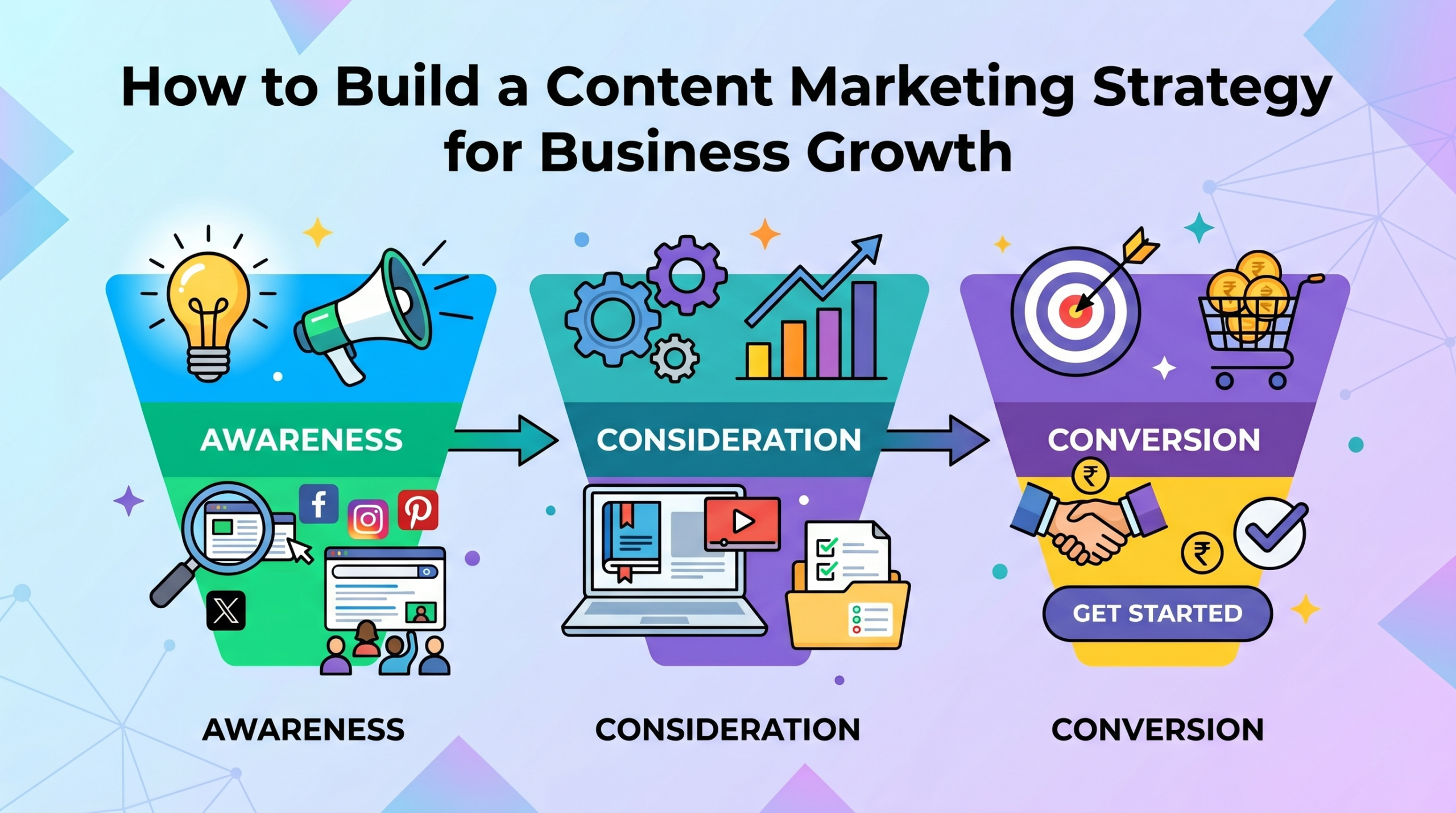
4. Supports the Sales Funnel
Content guides potential customers from awareness to purchase.
The 7-Step Content Marketing Strategy Framework
This framework is designed for businesses that want predictable growth from content marketing.
Step 1 — Define Clear Business Goals
Start with measurable outcomes.
Examples:
- Increase website traffic by 40% in 6 months
- Generate 50 qualified leads per month
- Improve conversion rate by 20%
- Rank on the first page of Google
SMART Goal Example
Increase organic website traffic from 5,000 to 8,000 monthly visitors within 6 months.
Step 2 — Identify Your Target Audience
Understanding your audience is the foundation of effective content marketing.
Key Audience Factors
- Age
- Location
- Industry
- Job role
- Pain points
- Buying behavior
Example Audience Persona
Business Owner
Age: 30–50
Goal: Generate more leads
Challenge: Low website traffic
Step 3 — Conduct Keyword Research
Keyword research determines what your audience is searching for.
Types of Keywords to Target
Primary keywords
High-volume search terms
Secondary keywords
Related variations
Long-tail keywords
Specific search queries
Example Keyword List
Primary keyword
content marketing strategy
Secondary keywords
content marketing plan
content marketing framework
content marketing examples
content marketing process
content marketing ROI
content marketing tools
Long-tail keywords
content marketing strategy for small business
how to create a content marketing plan
content marketing strategy in India
Step 4 — Create High-Quality Content
Content should solve real problems.
Types of Content That Perform Best
Blog posts
Case studies
How-to guides
Videos
Infographics
Email newsletters
Social media posts
Content Quality Checklist
Your content should be:
Helpful
Relevant
Accurate
Actionable
SEO optimized
Easy to read
Step 5 — Build a Content Calendar
Consistency is one of the biggest ranking factors.
Sample Monthly Content Plan
Week 1
Blog post
Week 2
Case study
Week 3
Educational guide
Week 4
Industry insights
Recommended Publishing Frequency
Small business
2–4 posts per month
Growing business
4–8 posts per month
Enterprise
8–16 posts per month
Step 6 — Distribute and Promote Your Content
Publishing content is only half the job.
Promotion drives traffic.
Best Content Distribution Channels
Search engines
Social media
Email marketing
Paid advertising
Guest posting
WhatsApp marketing
LinkedIn marketing
Step 7 — Measure Performance and Optimize
You cannot improve what you do not measure.
Important Content Marketing Metrics
Website traffic
Lead generation
Conversion rate
Bounce rate
Time on page
Cost per lead
Return on investment
Real Example — Content Marketing Strategy for a Local Business
Business
Digital marketing agency
Goal
Generate more leads
Strategy
Publish SEO blogs
Create social media content
Run targeted ads
Send email campaigns
Result
Increase in website traffic
More inquiries
Higher sales
Common Content Marketing Mistakes to Avoid
1 — Publishing Content Without a Strategy
Random content rarely generates results.
2 — Ignoring SEO
Without SEO, your content will not rank.
3 — Not Tracking Performance
Data drives improvement.
4 — Inconsistent Publishing
Consistency builds authority.
5 — Focusing Only on Sales
Content should educate first.
Tools to Manage Your Content Marketing Strategy
Google Analytics
Google Search Console
SEMrush
Ahrefs
Canva
WordPress
HubSpot
These tools help with:
Keyword research
Content planning
SEO optimization
Performance tracking
When Should You Hire a Content Marketing Agency?
Consider hiring an agency if:
You lack in-house expertise
Your website traffic is low
You need faster growth
Your competitors rank higher
You want measurable ROI
At Cognidigit, we provide end-to-end content marketing solutions, including:
SEO strategy
Content creation
Website development
Social media marketing
Lead generation campaigns
Performance tracking
Frequently Asked Questions (FAQ)
What is a content marketing strategy?
A content marketing strategy is a plan that outlines how businesses create and distribute content to attract and convert customers.
How long does content marketing take to show results?
Most businesses see measurable results within:
3 to 6 months
How often should businesses publish content?
Recommended frequency:
2 to 8 pieces of content per month
Is content marketing better than paid advertising?
Content marketing provides long-term traffic, while paid ads deliver short-term results.
The best approach combines both.
What is the cost of content marketing in India?
Typical monthly investment:
depends on:
Business size
Content volume
Marketing goals
Conclusion
A well-defined content marketing strategy is one of the most powerful tools for business growth in 2026. It helps attract the right audience, build trust, and convert visitors into customers.
Businesses that invest in structured content marketing today will dominate search rankings tomorrow.
If you want predictable leads, higher traffic, and measurable ROI, the next step is to implement a data-driven content strategy.
Ready to grow your business with a proven content marketing strategy?
Contact Cognidigit today for:
SEO services
Content marketing services
Website development
Digital marketing strategy
Lead generation campaigns
Let’s build your growth engine.