The search landscape is fragmenting at record speed. Voice assistants, AI chatbots, and Google’s Search Generative Experience (SGE) are reshaping how users discover information, forcing marketers to master Answer Engine Optimization (AEO) alongside traditional Search Engine Optimization (SEO). Understanding where these disciplines overlap—and where they diverge—can spell the difference between sustained visibility and vanishing clicks. This in-depth guide demystifies the two approaches, outlines concrete tactics, and prepares your brand for the zero-click era.
The Bedrock of Traditional SEO
Search Engine Optimization remains the backbone of organic visibility, driving more than half of all website traffic worldwide[1][2].

Illustration showing digital marketers analyzing search engine optimization using a computer, magnifying glass, and symbolic icons for optimization and goals.
Core Objectives
SEO improves rankings on search engine results pages (SERPs) to attract clicks and on-site engagement. Success is measured by keyword positions, organic sessions, click-through rate (CTR), time on page, and conversions[3].
Keyword-First Methodology
Marketers still rely on search-volume research to map intent to specific phrases, optimizing headings, meta tags, and comprehensive content clusters for each topic[4][5].
Technical & Off-Page Pillars
Site speed, mobile friendliness, internal linking, HTTPS adoption, and authoritative backlinks remain foundational. Pages that rank for voice queries, for instance, load 52% faster than the average web page[6].
The Rise of Answer Engine Optimization
Illustration of a robot using voice recognition technology to interact with a human speaker, symbolizing Answer Engine Optimization (AEO).
What Exactly Is AEO?
AEO focuses on answer engines—AI systems that surface a direct answer rather than a list of links. These include voice assistants, Google AI Overviews, Bing Copilot, ChatGPT, and Perplexity AI. Instead of enticing a user to click through, AEO positions your brand as the cited authority inside the answer itself.
Market Forces Driving Adoption
- Voice search ubiquity: 41% of U.S. adults now use voice search daily, while global voice-assistant installations exceed 8.4 billion devices.
- Zero-click dominance: Roughly 65% of Google queries end without a click, climbing to 75% on mobile.
- Generative summaries: Google’s AI Overviews can reduce clicks to the #1 organic result by 34.5% for informational queries.
SEO vs. AEO: Five Critical Fault Lines
| Dimension | SEO | AEO |
| Primary Platform | Search engines (Google, Bing) | Answer engines (AI Overviews, voice assistants, chatbots) |
| User Query Style | Short, keyword-centric text | Conversational, question-based, often voice |
| Content Format | In-depth articles & pillar pages | Concise, direct answers + structured snippets |
| Technical Focus | Crawlability, backlinks, Core Web Vitals | Schema markup, FAQPage & HowTo, knowledge graph alignment |
| Success Metric | Clicks & sessions | Citation frequency, share of voice in AI outputs, brand recall within answers |
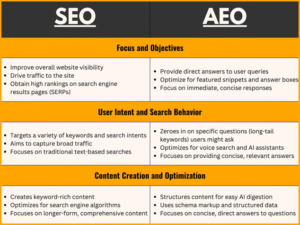
Infographic highlighting key differences between SEO and AEO in digital marketing, focusing on objectives, user intent, and content optimization strategies.
- Platforms & Distribution
SEO lives in the ten blue links; AEO favors answer boxes, featured snippets, knowledge panels, and AI chat interfaces that may never send traffic at all.
- Intent & Query Length
AEO targets the who/what/where/how phrasing users naturally speak to Alexa or Google Assistant, while SEO still accommodates head terms like “email marketing agency.” Long-tail, conversational keywords increasingly dominate (58% of queries are now conversational).
- Content Strategy
– SEO: Comprehensive, authoritative, 1,500-word guides targeting clusters of related keywords.
– AEO: 40-to-60-word answer blocks placed above the fold, backed by bullet points, data tables, and explicit “Question/Answer” headings.
- Technical Schema & Structured Data
While schema is optional for ranking, it is essential for AEO. Pages using FAQPage, HowTo, Product, or QAPage markup are far more likely to be pulled into voice answers and AI summaries.
- Measurement & KPIs
SEO dashboards highlight organic visits; AEO requires tracking “citation mentions” inside chatbots or monitoring how often your FAQ appears in Google’s AI Overviews.
The Zero-Click Challenge
SGE experiments show organic traffic drops ranging from 18% to 64% across 23 tech sites. Even top publishers observe a 34.5% fall in CTR when AI Overviews replace classic SERPs. Brands that ignore AEO risk invisibility—regardless of their current ranking.
Tactics to Win at AEO Without Abandoning SEO
- Lead With the Answer
Open blog posts or service pages with a concise, fact-based statement. Google prefers snippets averaging 29 words for voice results.
- Implement Rich Structured Data
Add JSON-LD markup for FAQ Page and How To sections. This not only amplifies visibility in AI snippets but also improves chances to appear in People Also Ask boxes.
- Optimize for Conversational Language
Rewrite headings as full questions (e.g., “What is AEO?”). Incorporate transitional phrases and natural speech patterns to mirror voice queries.
- Build Topical Authority
E-E-A-T remains vital. Maintain bylines, author bios, and first-party data to signal expertise—especially important as AI models evaluate source trust.
- Monitor Citation Share
Use tools like GSC’s “Search Appearance” report and manual audits of AI Overviews to track how often your domain is referenced, even when no click occurs.
Integrating SEO & AEO: A Hybrid Playbook
- Dual-Layer Content: Publish long-form articles (SEO) with embedded Q&A modules (AEO).
- Mixed Keyword Map: Pair high-volume head terms with natural-language sub-questions in the same piece.
- Performance Dashboard: Combine classic metrics (sessions, rankings) with emerging ones (snippet presence, voice answer share).
- Iterative Testing: Refresh answer blocks quarterly; AI systems retrain frequently and may replace citations if newer sources emerge.
Preparing for the Future of Search
AI chatbots currently command just 3% of total search traffic, yet their visits grew 81% year-over-year. Google’s plan to roll AI Overviews out to a billion users by year-end accelerates the shift. Brands that embed AEO fundamentals today will safeguard relevance as generative interfaces mature.
Conclusion
SEO is not dead, but its monopoly on discovery is over. Answer Engine Optimization addresses the growing reality that many users don’t click—they simply ask and expect instant clarity. By layering concise answers, structured data, and conversational keyword targeting atop your existing SEO framework, you’ll thrive across both link-driven and answer-driven ecosystems.
Digital marketers who master this dual approach will own the dialogue—whether a prospect scrolls, speaks, or chats.